


A senior leader may see themselves as decisive and efficient. Their team may experience something different: decisions made too quickly, alternative views cut off, or concerns left unspoken. Neither picture is necessarily wrong. They are two views of the same behaviour, and the gap between them is where self-awareness becomes relevant.
Knowing who you believe you are is not always the same as recognising how others experience your behaviour. That gap can be difficult to see from the inside, particularly when your intentions differ from the effect you have on others.
In this article, you’ll explore what self-awareness means, the different forms it can take, why it matters for decision-making and relationships, and practical ways to develop it. We’ll also look at how it shapes leadership and the blind spots that can make it harder to develop.
What Is Self-Awareness?
Recognising your thoughts, emotions, behaviours, motivations and recurring patterns as they arise is central to self-awareness. It involves creating enough distance to observe your own responses rather than automatically acting on them.
Recognising your limitations is part of that process, but self-awareness is not the same as self-criticism. Noticing that you tend to avoid conflict, for example, is not a judgement about your character. It is information you can use to understand a recurring pattern and consider a different response.
Self-Perception vs. Behavioural Reality
Self-perception is how you understand yourself, while behavioural reality is what your actions communicate to others.
| Self-Perception | Behavioural Reality |
| How you see yourself | How others experience your actions |
| Your values and intentions | The effect of your behaviour |
| What you believe you are communicating | What people actually observe |
A leader may see themselves as decisive, for example, but routinely shutting down alternative views can cause colleagues to experience that decisiveness as closed-off rather than confident. Both perspectives can be true.
This is where identity and impact become useful. Your identity reflects who you believe you are and intend to be; your impact reflects what your behaviour produces. Comparing the two can reveal habits or assumptions that are difficult to notice from the inside.

What Are the Types of Self-Awareness?
Different forms of self-awareness focus on different parts of how you experience yourself and how others experience you.
Internal Self-Awareness
Your emotions, thoughts, values, motivations, physical reactions and recurring triggers all offer insight into what is happening internally. This form of self-awareness helps you notice those patterns as they occur. You might notice, for instance, that uncertainty makes you want to control every detail of a project. Recognising that pattern gives you a moment to examine the reaction rather than automatically acting on it.
This distinction matters because self-awareness is not limited to understanding what happens within you. As Gaj Ravichandra explains, “Leadership effectiveness requires us to consider two interconnected dimensions: the inward and the outward.”
External Self-Awareness
How other people experience your behaviour can reveal aspects of external self-awareness that are difficult to see on your own. You might view your communication style as direct and efficient, while colleagues experience it as abrupt.
Understanding your own values and motivations does not necessarily tell you how your behaviour affects others. Strong self-awareness therefore involves looking in both directions: inward at what drives your responses and outward at what those responses produce.
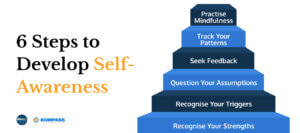
How to Develop Self-Awareness: 6 Practical Steps
Developing self-awareness is less about changing who you are and more about building habits that help you notice your patterns, test your assumptions and adjust your responses.
1. Practise Mindfulness and Notice What Is Happening
This doesn’t require long, formal sessions. Brief pauses during the day can help you notice what is happening before you automatically respond. During a disagreement, for example, you might notice your breathing becoming shallow, your body tensing or an urge to interrupt. Pause, register what you are noticing, then decide how you want to proceed.
2. Track Your Emotions and Behavioural Patterns
After an important interaction, briefly note what happened, what you felt and thought, how you responded, what may have triggered it, and what happened afterwards. This kind of self-reflection can help you spot patterns that are difficult to see at the moment. You don’t need to record every emotion; focus on situations or responses that recur.
When reflecting, ask “What am I reacting to right now?” before “Why am I so angry?” This helps you identify the immediate trigger and your response before interpreting what happened. Over time, these notes can reveal patterns linked to particular situations, people or pressures.
3. Seek Feedback From Other People
Feedback gives you an outside view of how your behaviour is experienced. Ask trusted colleagues for constructive feedback and specific observations rather than general impressions, and look for patterns across several conversations. Depending on your role, that outside perspective might also come through coaching supervision, where practice, assumptions and responses can be examined in a structured setting.
Instead of asking, “How did I handle that?”, try, “What’s one thing I could do differently in our next project meeting to make it easier for people to contribute?” A specific, forward-looking question gives you something you can apply.
4. Question Your Assumptions, Habits and Motivations
When something frustrates you or doesn’t go as expected, examine the explanation you are giving yourself. Ask: What am I assuming? What am I actually trying to achieve? What might I be avoiding? What evidence supports my interpretation, and how might someone else see it? The aim isn’t to distrust your judgement, but to test it before treating your first interpretation as fact.
5. Recognise Your Emotional Triggers
Certain situations can reliably produce a stronger reaction than the situation itself warrants. Unclear expectations, for example, might make you impatient and more controlling than usual. When you notice that pattern, identify the trigger and the first signs of the reaction. The goal isn’t to remove the emotion, but to create enough space to choose what to do next.
6. Recognise Your Strengths as Well as Your Challenges
Pay attention to what you consistently do well, as well as where those strengths stop serving the situation. A highly analytical leader may make careful, well-supported decisions but delay action by gathering more information than necessary. The same quality that supports good judgement can become a limitation when it is applied beyond what the situation requires.

What Does Self-Awareness Look Like in Everyday Life?
In practice, it shows up in ordinary moments. You might notice that criticism makes you defensive, that you keep avoiding a particular conversation, or that certain meetings leave you drained while others energise you. You may also catch an early physical cue: your jaw tightens, your breathing speeds up, or you feel an urge to interrupt. Noticing these signals gives you a chance to pause before the reaction becomes visible in what you say or do.
Under pressure, familiar habits tend to surface. You might withdraw from a difficult discussion, over-explain a decision, push for immediate agreement or step in to regain control when something feels uncertain. For example, if your speech speeds up when a colleague challenges your proposal, recognising that change can give you a moment to slow down and hear the concern before responding.
The same pattern can appear in how you use your strengths. A leader who repeatedly fixes a team member’s work may see it as maintaining high standards, but if the work is being taken over mainly because mistakes or uncertainty feel uncomfortable, the behaviour may be serving the leader’s need for control more than the team’s development.
Benefits of Self-Awareness
A clearer view of your own patterns can shape how you make decisions, manage relationships, regulate emotions and use your strengths.

Better Decision-Making
Noticing an emotional reaction before it influences a decision can lead to more considered judgement. It can also make confirmation bias easier to recognise, reducing the tendency to favour evidence that supports a decision you’ve already made.
A manager, for example, may be more willing to reconsider a strategy when the data no longer supports it, rather than continuing simply because changing course would mean admitting the original decision was wrong.
Stronger Relationships
A clearer sense of how you come across can make it easier to hear difficult input without becoming defensive. You may also become better at recognising when your own frustration or pressure is contributing to tension, rather than assuming the other person’s behaviour is the whole problem.
Greater Emotional Regulation
Self-awareness can help you manage difficult emotions before they dictate your behaviour. Recognising frustration, pressure or defensiveness early gives you more choice in how you respond, making it easier to pause, consider your options and handle the situation deliberately. This awareness also provides a foundation for self-regulation, particularly when emotions are strong or situations are demanding.
Personal and Professional Growth
A realistic view of your strengths and limitations makes it easier to adjust when a familiar strength stops serving the situation. Decisiveness can become control, confidence can lead to dismissing other perspectives, and attention to detail can make delegation harder. Recognising these patterns helps you adapt without treating the strength itself as a flaw.
More Effective Leadership
For leaders, greater self-awareness can improve how you make decisions, handle relationships and respond to difficult feedback. Recognising blind spots and understanding how your behaviour affects others can also make it easier for people to raise concerns, challenge ideas and contribute openly.
Self-Awareness vs. Self-Consciousness: What Is the Difference?
The two are easy to confuse, but they direct your attention in different ways. Self-consciousness tends to centre on judgement: Do they think I handled that badly? Do they think I’m capable? Self-awareness turns that attention towards understanding what is happening: I’m becoming defensive. What’s triggering that? Is my approach helping this conversation?
The difference is not whether you think about yourself, but where that attention takes you. Self-consciousness can leave you preoccupied with how you are being perceived, while self-awareness helps you examine what is happening and make a more deliberate choice about what to do next.
How Does Self-Awareness Relate to Emotional Intelligence?
Self-awareness is one part of emotional intelligence, alongside regulating your own emotions, recognising emotional cues in others and managing relationships effectively. The two are closely connected: noticing your frustration during a difficult conversation, for example, can help you regulate your response and remain receptive to what the other person is saying.
Self-Awareness in the Workplace: Why It Matters for Leaders
In leadership, self-awareness becomes particularly important because your decisions, behaviour and responses can influence how other people work, communicate and contribute.

Self-Awareness and Communication
Much of workplace communication runs into trouble at the gap between intention and impact. A leader who cuts a discussion short may intend efficiency; the team may experience it as dismissiveness. Leaders often evaluate their own communication by what they meant, while the people around them experience it through what actually happened. Closing that gap requires paying attention to both.
Self-Awareness and Decision-Making
Personal preference, unexamined assumption and the pull of a previous success all shape decisions in ways that are easy to miss from the inside. A leader might keep using an approach that worked well in the past, even as the evidence suggests the current team or situation calls for something different.
Self-Awareness and Leadership Blind Spots
Strengths that once served a leader well can quietly become limitations. Greater seniority can make this harder to recognise because candid feedback may become less available as people become more cautious about challenging someone in authority.
For some leaders, executive coaching provides a structured setting to examine patterns that are difficult to see without an outside perspective.
Leaders also influence the emotional tone around them. When frustration or anxiety is expressed without much restraint, people may become more cautious about speaking up or taking risks. A leader who visibly reacts with frustration whenever a proposal challenges their preferred approach may eventually find that fewer people bring alternative ideas forward, not because the ideas have stopped, but because raising them no longer feels worth it.
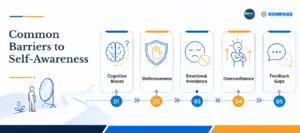
Barriers to Self-Awareness
Several factors can make it harder to see your own patterns clearly, particularly when the information challenges how you understand yourself.
Cognitive Biases and Blind Spots
Confirmation bias and selective attention can reinforce an existing view of yourself by making supporting information easier to notice than contradictory evidence. Looking deliberately for information that challenges your assumptions can help expose what you may be missing.
Defensiveness
Feedback can feel threatening when it conflicts with an identity you’ve built over time. A leader who sees themselves as fair or competent may instinctively defend behaviour that challenges that view. Instead of immediately asking, “Is this person wrong?”, try asking, “What part of this is difficult for me to hear?”
Avoiding Uncomfortable Emotions
Frustration, anxiety or dissatisfaction can be pushed aside rather than examined. When uncomfortable feelings are treated only as something to suppress, you may miss information about a recurring situation, need or behaviour.
Overconfidence in Your Self-Perception
Feeling self-aware does not guarantee that your view of yourself is accurate. Overconfidence bias can make it easier to overestimate the accuracy of your own judgement, particularly when you have a strong track record or considerable experience. Feedback and observation can help reveal gaps between what you believe and what others experience.
Seniority and Reduced Access to Candid Feedback
As people become more senior, colleagues may become less comfortable challenging them directly, while past success can reinforce confidence in familiar instincts. Seniority does not automatically reduce self-awareness, but it can make certain blind spots harder to detect.
How Do You Know If Your Self-Awareness Is Improving?
Progress shows up in behaviour, not simply in how much you reflect. Look for signs such as:
- You notice reactions earlier, before frustration or defensiveness shapes your response.
- You recognise recurring patterns sooner, rather than needing the same situation to happen repeatedly.
- You can acknowledge mistakes without immediately defending them.
- You become more open to perspectives that challenge your assumptions.
- You have more choice under pressure, even in situations that once triggered an automatic response.
Self-awareness becomes meaningful when greater insight changes how you respond, not simply how much you reflect.
Build Self-Awareness Through Consistent Practice
Self-awareness develops gradually as you apply what you’ve noticed to real situations. Rather than trying to change everything at once, focus on one recurring behaviour or assumption and pay attention to what happens when you approach it differently.
The goal isn’t to analyse yourself constantly or achieve perfect self-knowledge. It is to become more intentional in the situations that matter.