

Running a business in today’s world isn’t easy. Leaders are expected to manage change, inspire teams, and make smart decisions in the face of constant uncertainty. That’s where executive coaching comes in.
In 2025, coaching is no longer a luxury for senior leaders. It’s a vital part of leadership development.
At Kompass Consultancy, we work with companies across Dubai and beyond to help leaders grow, adapt, and thrive. In this guide, we’ll explore why executive coaching matters now more than ever, and how it fuels real leadership development.
What Is Executive Coaching and Why Does It Matter in 2025?
Executive coaching is a structured, one-on-one process in which a trained coach supports a leader in improving performance, making informed decisions, and unlocking their full potential. Unlike mentoring, where advice is based on personal experience, coaching is about asking the right questions and guiding leaders to discover their own solutions.
In 2025, the pace of business has continued to accelerate. Hybrid workplaces, AI-driven technologies, and shifting market demands necessitate that leaders adapt quickly. Executive coaching provides the personalised support leaders need to stay ahead.
Why Do Leaders Need Executive Coaching More Than Ever?
Today’s executives face a unique mix of pressures:
- Navigating digital transformation and AI adoption.
- Leading teams across hybrid and global environments.
- Meeting rising expectations for empathy, resilience, and inclusion.
Imagine a regional CEO in Dubai tasked with rolling out AI-driven systems across multiple markets. While the technology promises efficiency, their managers feel anxious about job security, and team morale is low.
Instead of focusing only on technical rollout, an executive coach works with the CEO to strengthen communication, address resistance with empathy, and create a vision that inspires confidence. The result is not just a smoother transformation, but a stronger, more engaged workforce.
A skilled coach acts as a sounding board, helping leaders think strategically, manage stress, and remain confident in uncertain times. For many companies, coaching has become an essential investment in leadership stability.
How Executive Coaching Supports Leadership Development
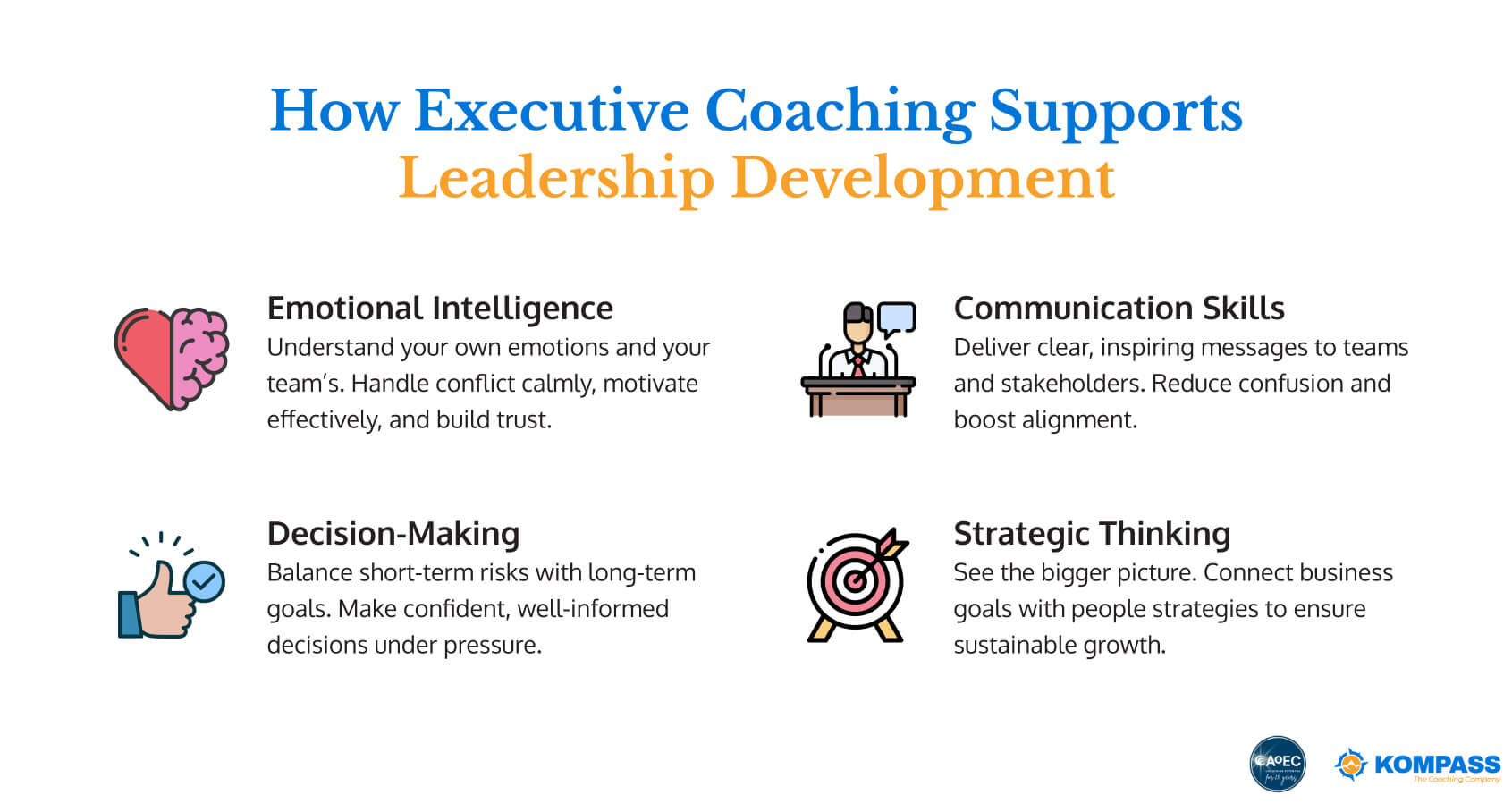
Leadership development is more than sending managers to training workshops. It’s about transforming how leaders think, behave, and engage with their teams. Executive coaching strengthens both soft skills and strategic abilities:
Emotional intelligence
Coaching helps leaders better understand their own emotions and those of their teams. With higher emotional intelligence, they can handle conflict calmly, motivate people, and build stronger trust.
Communication skills
A coach sharpens how leaders deliver messages, whether it’s inspiring teams, addressing challenges, or presenting to stakeholders. Clear communication reduces confusion and boosts alignment across the company.
Decision-making
Leaders learn to balance short-term risks with long-term strategy. Through coaching, they develop frameworks for making confident choices, even under pressure, and avoid common decision-making biases.
Strategic thinking
Instead of just reacting to daily issues, coaching trains leaders to see the bigger picture. They learn to connect business goals with people strategies, ensuring growth is sustainable and future-focused.
Together, these skills create leaders who don’t just manage tasks. They guide teams toward lasting success.
Measurable Benefits of Executive Coaching
Research indicates that coaching yields tangible results for both leaders and organisations. Companies that invest in coaching often see:
- Higher employee engagement and lower turnover.
- Stronger workplace culture built on trust and accountability.
- Improved productivity and team performance.
- A clear succession pipeline for future leaders.
In fact, a Metrix Global study found that executive coaching delivers an impressive 788% return on investment (ROI), driven by productivity gains and higher employee retention. Similarly, the International Coaching Federation reports that companies using executive coaching experience stronger overall performance and higher employee satisfaction.
How Is Executive Coaching Different from Traditional Leadership Training?
While leadership training builds knowledge, executive coaching builds transformation. The differences are clear:
| Aspect | Leadership Training | Executive Coaching |
| Format | Group-based workshops or seminars | One-to-one, highly personalised sessions |
| Focus | Knowledge transfer and skill-building | Deep behavioral change and mindset shifts |
| Duration | Usually short-term (days to weeks) | Long-term (months to years) |
| Application | General concepts that may not fit all contexts | Tailored to the leader’s real-world challenges |
| Outcome | Immediate learning, limited reinforcement | Sustained growth, measurable leadership impact |
| Best For | Building broad competencies across teams | Developing high-potential or senior leaders |
This is why many organisations combine the two: training to expand knowledge and coaching to ensure lasting transformation.
Choosing the Right Executive Coach

Not every coach is the right fit. When choosing, consider:
- Experience and accreditation: A strong background in coaching and business leadership.
- Approach: Does their method align with your company’s culture?
- Chemistry: A coach-leader relationship must be built on trust and openness.
The right coach doesn’t give answers. They help leaders discover them.
Integrating Coaching into Leadership Development
More businesses are incorporating executive coaching into their long-term strategies to ensure continuous leadership growth, rather than just a one-off event. This often includes pairing coaching with leadership training workshops or offering coaching as part of executive onboarding, helping new leaders settle in quickly while building essential skills.
Companies are also creating internal “coaching cultures,” where feedback is open, constructive, and part of everyday work. By combining these approaches, organisations ensure that leadership development is ongoing, practical, and aligned with real business needs.
Future Trends in Executive Coaching and Leadership Development

The landscape is evolving. Key trends shaping coaching in 2025 include:
- Leveraging AI-assisted coaching tools to track progress and provide personalised insights.
- Adopting virtual and hybrid coaching models to offer flexibility and accessibility.
- Prioritising diversity, equity, and inclusion (DEI) by coaching leaders to build more inclusive teams.
- Supporting new generations of leaders by tailoring approaches for millennials and Gen Z executives.
These shifts will make coaching even more accessible and impactful.
Investing in Executive Coaching: A Strategic Advantage for 2025 and Beyond
Executive coaching is not just about individual growth. It’s about organisational success. When leaders become stronger, companies see higher performance, innovation, and adaptability.
In today’s competitive world, businesses that invest in coaching gain a strategic advantage. They’re able to attract and retain talent, adapt to change, and future-proof their leadership teams.
Kompass Consultancy Develops Leaders Who Thrive
We recognise that leadership challenges in Dubai and the broader region are distinct. Our executive coaching programs are designed to provide personalised support to senior leaders, aligning leadership growth with your business strategy and building skills that drive long-term organisational success.
Whether you’re strengthening your leadership pipeline or supporting C-suite executives, our coaches bring global expertise with local insight. Ready to invest in your leaders? Contact Kompass Consultancy today to discover our executive coaching and leadership development solutions.
Frequently Asked Questions
What is executive coaching, and why is it important for leadership development?
Executive coaching is a personalised process where a trained coach helps leaders improve performance, decision-making, and team engagement. It’s essential for leadership development because it fosters both skills and confidence, enabling leaders to drive long-term organisational success.
How does executive coaching differ from traditional leadership training?
Leadership training focuses on group learning and knowledge transfer, while executive coaching is one-to-one, tailored to real-world challenges, and drives lasting behavioral change. Many organisations combine both for maximum impact.
How can I measure the impact of executive coaching in my organisation?
Impact can be measured through metrics like employee engagement, retention rates, productivity improvements, and ROI. Studies, such as those by Metrix Global, show executive coaching can deliver up to 788% ROI, alongside higher team performance and satisfaction.
Who should participate in executive coaching programs?
Executive coaching is ideal for senior leaders, high-potential managers, and C-suite executives. It can also benefit teams or organisations looking to strengthen leadership pipelines and foster a culture of continuous growth.
What should I look for when choosing an executive coach?
Look for a coach with relevant experience, professional accreditation, and a coaching style that aligns with your company culture. Chemistry and trust are crucial. The right coach helps leaders discover their own solutions rather than providing all the answers.