There comes a point in many leadership journeys where a shift begins to take shape. The targets are being met and the team is performing, yet there is a growing sense that something essential is missing. It is rarely a crisis, but more often a recognition that directing people towards outcomes is not the same as developing them, and that having the answers may, over time, create teams that wait rather than think.
This reflects a defining tension in organisational life, where leaders deliver results but do not always build capability beneath them, and teams begin to rely rather than grow.
This is not a failure of leadership. It is an invitation to rethink the relationship between leadership and coaching, and what leadership development can become when the two are meaningfully integrated.
What Leadership Development Means Today
Leadership has always been about creating the conditions for progress, setting direction, aligning people, and holding accountability in complex and uncertain environments. While these expectations remain, the way leaders are developed is beginning to shift.
Leadership development is moving beyond competence alone. Frameworks and skills still matter, but they are no longer sufficient in isolation. What is increasingly required is awareness, the ability to understand how one’s thinking and behaviour shape the people and systems around them. This is where the connection between leadership and coaching begins to emerge, often explored further through executive coaching.
Without reflection, leadership can become repetitive. Patterns go unexamined, and even capable leaders may rely on familiar approaches that no longer serve the situation, limiting both their effectiveness and the growth of others.
This often shows up in subtle ways:
- Leaders continue to solve problems that others could take ownership of
- Decisions are escalated when capability exists within the team
- Leadership behaviours are repeated out of habit rather than intention
Coaching introduces a different kind of space, something often deepened through coaching supervision, allowing leaders to step back, examine their thinking, and lead with greater intention.
Coaching as a Different Kind of Leadership Conversation
A different way of engaging with leadership begins with how conversations are approached. If leadership is often associated with providing direction, coaching focuses on developing the thinking behind decisions and actions. Rather than offering answers, it creates space for reflection, allowing individuals to explore their own perspectives and arrive at their own conclusions.
This does not make coaching passive. A well-held coaching conversation is purposeful and structured, but its purpose is not to solve problems on behalf of someone else. It is to create the conditions in which people can think more clearly, act with greater awareness, and take ownership of their decisions.
Over time, this begins to shape how leaders think and lead. Coaching develops the ability to examine assumptions, understand the impact of behaviour, and remain thoughtful under pressure.
This often shows up in subtle ways:
- Leaders begin to question their assumptions rather than act on them automatically
- Decision-making becomes more deliberate and less reactive
- Conversations shift from instruction towards exploration
In our experience, this shift allows leadership development to move beyond short-term improvement towards more sustained and integrated change.
How Leadership and Coaching Work Together
In practice, this connection becomes clearer in how they shape growth, capability, and everyday interactions within organisations.
A Shared Focus on Growth and Performance
Despite their different approaches, leadership and coaching share a common focus. Both are concerned with helping individuals and teams grow beyond their current capabilities and move towards what they are able to become.
Both rely on trust and open communication, and neither works well where people feel unable to speak honestly. When done well, they create the conditions for potential to be realised rather than simply managed.
Leaders Developing Leaders
A significant shift in organisations today is the move from leadership concentrated at the top to leadership as a shared capability across the system.
In this context, developing people is not a separate function but part of how leadership is practised. Leaders are responsible not only for outcomes, but for the thinking and growth of those around them.
When coaching is integrated into leadership, everyday interactions begin to change. Leaders create space for others to think and take ownership, gradually reducing dependency and building capability across the organisation. This is often reflected in the quality of conversations across a team, something that can be further strengthened through team coaching in organisations.
Coaching as Part of Leadership Practice
Integrating coaching into leadership does not mean taking on the role of a coach. The two carry different responsibilities and boundaries.
What changes is how leadership is expressed. Leaders become more intentional in how they engage with others, recognising when to provide direction and when to create space for reflection.
This ability to move between leading and coaching reflects a more mature form of leadership, one that supports both performance and development over time.
Key Differences Between Leadership and Coaching
Although the two are closely connected, their differences become clearer in how they are applied in everyday situations.
Providing Direction vs Enabling Discovery
The most fundamental difference lies in their relationship to answers lies in their relationship to answers. Leadership is often oriented towards direction, clarifying where a team or organisation needs to go and creating the conditions for getting there. Coaching focuses on discovery, supporting individuals to develop their own clarity, insight, and way forward.
Neither is superior. They serve different purposes, and the skill lies in recognising which is needed in the moment.
Authority vs Shared Thinking Space
Leadership carries authority, whether positional or earned, and this shapes how conversations unfold. People respond differently when accountability and evaluation sit within the relationship.
Coaching, by contrast, creates a shared thinking space where hierarchy is set aside in service of exploration. The role is not to direct, but to think alongside.
When leaders integrate coaching into their approach, this shift requires intention. It often involves signalling that the conversation is different and creating space for more open reflection.
Driving Outcomes vs Exploring Process
Leadership is typically accountable for outcomes, timelines, and delivery. Coaching focuses on the thinking and behaviour that shape those outcomes.
This does not make coaching disconnected from results. In practice, greater attention to process often leads to more effective and sustainable outcomes over time.
Immediate Action vs Sustainable Change
Leadership often needs to respond to immediate demands, where clarity and action are required. Coaching takes a longer view, building the awareness and capability that support lasting change.
Both are necessary. However, when organisations focus only on the immediate, they often find the same challenges repeating and leaders becoming increasingly stretched.
Sustainable change requires a different kind of investment. In our experience, coaching is one of the most consistent ways of enabling it.
The Advantages of Integrating Leadership and Coaching
When these approaches are intentionally integrated, the advantages extend beyond individual performance into how leadership development is experienced across the organisation.
In practice, this can be seen in a number of shifts:
From Individual Performance to Systemic Growth
The impact of coaching does not remain with the individual. As leaders change how they engage, the quality of conversations within teams begins to shift. Over time, this influences how the wider system learns, adapts, and develops.
Stronger Ownership and Reduced Dependency
When leaders create space for thinking rather than providing answers, individuals begin to take greater ownership of their work. Decisions move closer to where the knowledge sits, and teams become less reliant on constant direction.
More Sustainable Leadership Development
Learning that is reflected on and applied in real situations tends to endure. Coaching supports leaders in translating insight into practice, allowing development to take hold beyond formal programmes.
A Cultural Shift Towards Trust and Openness
As coaching-informed conversations become more consistent, they begin to shape the wider culture. Trust builds through repeated experience, and organisations become more open, collaborative, and responsive over time.
The Three Levels of Leadership Development
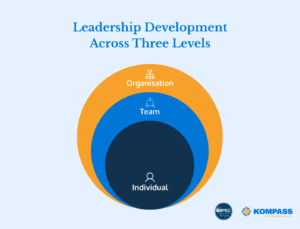
It unfolds across three levels, each influencing how leaders think, relate, and lead.
Individual Level: Awareness and Behaviour
At the individual level, leadership development focuses on the inner landscape of the leader, where emotional intelligence becomes a core capability. How a leader responds under pressure, the patterns that emerge in uncertainty, and the assumptions shaping decisions all begin to matter. Examining these allows leaders to act with greater intention rather than habit.
Team Level: Relationships and Alignment
At the team level, the focus shifts to the quality of interaction between people, where communication is defined by honesty, depth, and the ability to engage with difficult realities. Over time, this builds trust and shared accountability, enabling teams to take ownership without constant oversight.
Organisational Level: Culture and Capability
At the organisational level, the focus is on whether leadership development is consistent and embedded, or dependent on individual managers. Organisations that integrate coaching create an expectation that leaders develop leaders, building a more self-sustaining system that grows its people from within.
Developing a Coaching Approach Within Leadership
A coaching approach within leadership is less about adopting a new technique and more about shifting how you engage with others. It often begins with a simple change, resisting the instinct to provide answers and instead creating space for others to think. In practice, this means recognising that the person in front of you is often more capable than the situation allows, and that a well-placed question can create more value than a quick solution.
This does not require additional time or formal structure. Even in high-pressure environments, small moments of reflection can change the quality of thinking and decision-making. Over time, the distinction becomes less about choosing between leading and coaching, and more about developing the awareness to move between both, responding to what the situation requires.
Leadership and Coaching in Practice
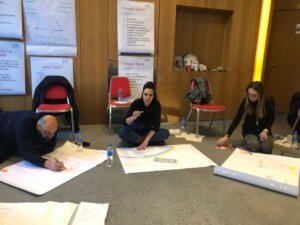
The real potential lies not in isolated interventions, but in how development becomes part of everyday organisational life. Rather than being delivered through programmes alone, it takes shape through conversations, relationships, and the way leaders engage with those around them.
Over time, this creates a shift from dependency to shared capability. Leadership becomes less about having the answers and more about enabling better thinking across the organisation. You may begin to notice where your own leadership creates answers, and where it creates space for others to think.
Key Takeaways
Choosing between leadership training and executive coaching is less about preference and more about what the situation requires.
- Leadership training builds capability at scale, creating shared frameworks, language, and consistency across teams.
- Executive coaching develops individual capacity, strengthening how leaders think, decide, and operate in complex situations.
- The most effective development often combines both, using training for structure and coaching for deeper integration in practice.