Key Takeaways
Many workplace disagreements stem from unclear expectations, competing priorities, or assumptions rather than personal differences.
- Resolving difficult situations effectively requires active listening, curiosity, and a willingness to explore underlying interests.
- Lasting outcomes depend on clear commitments, accountability, and appropriate support when direct resolution is not enough.
- Strong leaders and self-aware professionals create healthier working relationships by modelling constructive responses to disagreement.
Most people assume that conflict is a sign something has gone wrong. In reality, disagreement is an inevitable part of working with others. The question is not whether differences will arise but how they are handled.
Healthy organisations are not free from disagreement. They are defined by how they respond to it. Conflict rarely begins with a dramatic falling-out. More often, it develops when small issues are left unaddressed.
Resolving conflict well is a professional capability built on strong interpersonal skills. It helps individuals and teams navigate differences more constructively while supporting stronger working relationships over time.
What Is Conflict Resolution?
Conflict resolution is often mistaken for avoiding or simply managing disagreement. While those approaches may have a place, they are not the same. Understanding the distinction helps professionals choose the most appropriate response for each situation.
Conflict Avoidance
Choosing to ignore or delay a difficult issue in the hope that it disappears on its own rarely works. Over time, unresolved tension often resurfaces, making the situation more difficult to address.
Conflict Management
Reducing the immediate impact of a disagreement allows work to continue while limiting unnecessary disruption. Although this can be an appropriate short-term approach, particularly in high-pressure situations, it does not necessarily address the underlying issue.
Conflict Resolution
Working towards greater understanding, clearer expectations, or a practical agreement helps people move forward more constructively. It does not require complete consensus. In many situations, the goal is not for everyone to think alike but to establish enough clarity to move forward with confidence.

Why Conflict Happens in the Workplace
Understanding why disagreements develop is often more valuable than deciding who is at fault. Most workplace issues have recognisable causes, and they are rarely as personal as they seem at first.
Unclear Expectations
When responsibilities, standards, or priorities are not defined clearly, colleagues naturally interpret them differently. Those differences create friction, making unclear expectations one of the most common and preventable causes of workplace disagreement.
Communication Breakdowns
Incomplete, poorly timed, or misunderstood information can create problems even when no one intended them. A message that seems clear to one person may be interpreted very differently by someone else, depending on context, previous interactions, or current pressures.
Competing Priorities
Teams and departments do not always work towards the same immediate objectives. What appears to be a personality clash may simply reflect competing organisational demands that have not been openly discussed.
Emotional Reactions
Stress, perceived unfairness, and uncertainty influence how people listen and respond. When someone feels criticised or threatened, the ability to think objectively often narrows. This is not a character flaw but a predictable human response that can shape even well-intentioned conversations.
Assumptions and Cognitive Bias
Few people enter a disagreement believing they are being unreasonable. There is a natural tendency to explain our own mistakes by pointing to circumstances while judging other people’s actions more harshly. If this feels familiar, it may be worth asking whether the situation is being viewed as completely as it could be.
Many workplace disagreements are symptoms of something deeper. Looking beyond the immediate issue often reveals the misunderstanding, expectation, or competing priority that needs to be addressed.
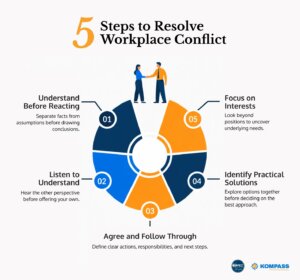
5 Practical Steps to Resolve Workplace Conflict
Difficult conversations rarely improve through delay. Although every situation has its own context, a structured approach can help managers and team members navigate challenging discussions more constructively.
1. Understand the Issue Before Reacting
The first step is separating facts from assumptions. Many disagreements escalate not because of what happened but because of the meaning people attach to it.
Before drawing conclusions, ask yourself: What do I know for certain, and what am I filling in? That pause may feel difficult under pressure, but it often prevents an unnecessary confrontation before it begins.
2. Listen to Understand, Not Simply to Respond
Active listening remains one of the most underused skills in the workplace. Giving someone the opportunity to explain their perspective without interruption or preparing your reply changes the quality of the discussion.
Feeling genuinely heard often reduces defensiveness. This does not require agreement. It demonstrates that the other person’s perspective has been considered before exploring possible solutions. Before offering your own view, ask yourself whether they feel they have been heard. That small shift can change the direction of the discussion.
3. Focus on Interests Rather Than Positions
One of the most valuable shifts in a difficult discussion is moving beyond positions to understand underlying interests. A position describes what someone says they want. An interest explains why it matters.
A team member who says, “I need this deadline extended,” is expressing a position. The underlying interest may be having enough time to produce work they feel confident in. Recognising that distinction often uncovers possibilities that neither person had initially considered.
One question worth bringing into these discussions is: “What does this solve for you?” It encourages people to explain the need behind the request rather than defend a preferred outcome. If you find yourself becoming fixed on a particular solution, it may be worth asking the same question of yourself.
4. Work Together to Identify Practical Solutions
Once there is enough shared clarity about the underlying interests, attention can shift towards what is workable. Framing the issue as a shared challenge encourages collaborative problem-solving rather than assigning blame.
One habit that often limits progress is evaluating ideas too quickly. When one person proposes an option and the other immediately points out its weaknesses, the discussion returns to defending positions instead of exploring possibilities. Remaining curious for a little longer, even when an idea feels imperfect, often leads to stronger outcomes.
Solutions developed together are more likely to last because everyone has contributed to shaping them.
5. Agree on Clear Actions and Follow Through
Many workplace disagreements return not because they were handled badly but because they ended without enough clarity. Good intentions at the end of a discussion are not the same as clear commitments.
Before leaving a difficult discussion, it is worth agreeing on who will do what, by when, and how progress will be reviewed. That level of specificity removes the ambiguity that allows the same issues to resurface weeks later.
If everyone leaves with a different understanding of what happens next, the issue has not really been resolved.

Why Conflict Resolution Matters
Organisations that handle disagreement well do more than create harmonious workplaces. They make better decisions. When concerns can be raised through open communication without fear of being ignored or dismissed, issues surface earlier, different perspectives are considered, and teams respond more effectively.
The benefits extend beyond individual interactions. Teams that address differences constructively adapt more effectively, encourage thoughtful challenge, and maintain momentum through change. Every difficult discussion handled well strengthens an organisation’s ability to navigate the next one.
When Third-Party Support May Be Necessary
Not every workplace disagreement can or should be addressed by the people directly involved. Situations involving repeated tension, significant power imbalances, formal grievances, or ongoing breakdowns in working relationships may require support from a manager, HR, or a neutral facilitator.
Seeking support is not an admission of failure. It recognises that some situations benefit from structure, impartiality, or a level of authority that those involved cannot provide themselves. If repeated attempts have not moved the situation forward, bringing in another perspective may be the most constructive next step.
Conflict Resolution as a Leadership Skill
How disagreement is handled is often shaped long before it arises. The example set by senior leaders, how concerns are raised, how consistently expectations are reinforced, and how mistakes are acknowledged establish the standards that others carry into their day-to-day working relationships.
One pattern worth examining is the instinct to act as an intermediary between colleagues in dispute. Although well-intentioned, this can delay the direct dialogue needed to resolve the issue. Encouraging people to address concerns respectfully themselves, while remaining available for support when necessary, often leads to more sustainable outcomes and greater confidence within the team.
Psychological safety is built through everyday actions. When a leader acknowledges that their perspective was incomplete or that a decision had unintended consequences, it gives others permission to do the same. If you lead others, your response to disagreement will often shape how your team responds in the future. Developing that level of awareness and communication often benefits from reflection, feedback, and executive coaching.

The Role of Self-Awareness in Conflict Management
Everyone has a default response when workplace tension arises. Some withdraw, while others become more assertive or fixed in their position. Developing self-awareness is not about changing your personality. It is about recognising those habits early enough to choose a more constructive response. If this feels familiar, that awareness is often where meaningful change begins.
Taking time before a difficult discussion can be valuable, but only if it is used for genuine reflection rather than mentally rehearsing the next argument. The most challenging part of resolving workplace disagreements is often not understanding the other person. It is approaching the conversation with enough clarity about your own assumptions to remain open to theirs.