
Most organisations do not struggle because of a shortage of good ideas or capable people. They struggle because the leaders responsible for executing those ideas are not fully aligned on what matters most and why.
In our experience working with leadership teams across industries and borders, misalignment rarely looks like open conflict. It looks like slow decisions, duplicated efforts, and a strategy that makes sense on paper but loses momentum in practice.
Aligning your leadership team is not about creating uniformity of thought or removing healthy tension. It is about ensuring that everyone steering the organisation is working from the same understanding of purpose, priorities, and direction.
Understanding Leadership Team Alignment
What it means for a leadership team to be truly aligned goes far deeper than agreeing on a strategy document or attending the same quarterly planning session. It operates across three dimensions that must work together.
True alignment begins with a shared understanding of the organisation’s mission and why it exists. Without this, individual leaders default to prioritising their own function over the collective direction, and those first cracks appear quietly, long before they become visible. Clarity on strategic objectives and how each leader’s area contributes to the broader picture is what keeps the team moving coherently, while an honest, shared view of the obstacles ahead is what separates a team that plans realistically from one that plans optimistically.
Think of it like a rowing team. Technical skill in each seat means very little if the crew is not moving in the same direction at the same time. Building that shared direction is where intentional team coaching makes its most meaningful contribution.

The Pillars of an Effective Leadership Team
Knowing what alignment looks like in theory is one thing. Building and sustaining it in practice requires attention to four foundations that support everything else a leadership team does.
Shared Vision and Purpose
Before a leadership team can align on what to do, they need to be genuinely aligned on why. A shared sense of purpose gives the team a reference point for every decision, particularly during periods of uncertainty or change.
Without it, leaders default to optimising for their own area rather than the collective direction, and that drift is often invisible until it has already done significant damage.
Defined Roles and Responsibilities
Ambiguity at the leadership level creates conflict, duplication, and missed accountability. When each leader understands not only their own responsibilities but also how those connect to and depend on the people around them, the team operates with far greater coherence.
Some of the most capable leadership teams we have worked with have unlocked significant performance gains simply by getting honest about where roles overlapped and where gaps existed.
Open Communication and Feedback Loops
Psychological safety within a leadership team is not a soft consideration. It is a structural one. When leaders feel safe enough to raise concerns, challenge assumptions, and give honest feedback, the quality of decisions improves considerably.
Without it, critical information stays unspoken and problems surface later than they should.
Trust and Accountability
A leadership team can have the right strategy, the right people, and the right resources, and still underperform if trust is absent. Accountability without trust produces compliance, while trust without accountability produces good intentions that rarely translate into results. The most effective leadership development programmes are those that treat trust and accountability not as separate objectives but as two sides of the same foundation.
Common Challenges Worth Addressing Early
Even well-intentioned leadership teams encounter barriers that pull them apart. Recognising these challenges early, and having a clear response to each, is what separates teams that recover quickly from those that drift for months.
Conflicting priorities emerge when leaders are measured on their own function rather than collective success. Establishing shared metrics gives the team a common definition of winning above individual KPIs.
Diverse leadership styles are a genuine strength, but only when differences are understood and respected. Regular facilitated conversations about how the team works together, not just what they are working on, are one of the most effective ways to turn that diversity into an advantage.
Poor communication channels create information gaps that compound quietly over time. Something as simple as a weekly alignment check-in can prevent months of duplicated effort and missed coordination.
Resistance to change usually stems from a lack of clarity, a fear of losing influence, or insufficient involvement in decision-making. Addressing those root causes directly tends to move things forward faster than any mandate.
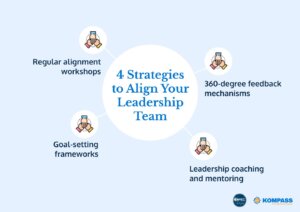
Strategies to Align Your Leadership Team
Alignment is not something a leadership team achieves once and maintains passively. It is built through consistent, deliberate practices that require the same ongoing attention as any other strategic priority.
Regular Alignment Workshops
Facilitated sessions that bring the leadership team together to revisit purpose, discuss priorities, and surface tensions are one of the most effective tools available. These conversations rarely happen naturally within the demands of day-to-day leadership, which is exactly why creating dedicated space for them matters.
Goal-Setting Frameworks
Without a shared framework, leadership teams often notice conflicting priorities only after problems arise. Tools like OKRs (Objectives and Key Results) or balanced scorecards provide a common language for tracking progress, helping teams spot alignment or gaps before they become costly.
360-Degree Feedback Mechanisms
Structured feedback processes help leadership teams understand how their behaviour and decisions land both within the team and across the organisation. They surface blind spots that are difficult to see from the inside and create a foundation for more honest, productive conversations.
Leadership Coaching and Mentoring
Individual coaching within a leadership team context strengthens the team as a whole. When each leader is developing greater self-awareness, communication skills, and strategic clarity, the collective capacity of the team grows alongside them.
The most effective executive coaching approaches are those that address both the individual leader and the team dynamic, recognising that one cannot be fully developed without the other.
Measuring the Impact of Alignment
Its effects are visible, measurable, and directly connected to organisational performance, showing that alignment is more than just a cultural aspiration. Knowing what to look for is what allows you to track progress and course correct when needed.
Team Performance Metrics
Decision-making speed, innovation output, and cross-functional collaboration give a quantitative view of how well the leadership team is functioning together. When these improve consistently over time, alignment is almost always a contributing factor.
Employee Engagement and Retention
Aligned leadership teams create clearer direction and more consistent cultures, both of which have a direct effect on how motivated and committed people feel throughout the organisation. Engagement and retention data are among the strongest indirect signals of how well the leadership team is functioning at the top.
Progress Towards Strategic Objectives
When a leadership team is genuinely aligned, the organisation moves faster and more coherently towards its goals. Tracking milestone achievement against the original plan is the most fundamental measure of whether alignment is translating into real momentum or remaining a conversation that never quite reaches the ground.

Inspiring a Culture of Alignment and Trust
Sustainable alignment is not maintained through frameworks and processes alone. It requires leaders who consistently model the behaviours they expect from others, because culture is shaped not by what leaders write in policy documents but by what they repeatedly do in the moments that matter most.
Bringing diverse viewpoints into the decision-making process, not just tolerating them but actively seeking them out, produces better outcomes and builds the kind of trust that holds a leadership team together during difficult periods. Teams that practise this consistently tend to surface better solutions and create a culture where people feel genuinely valued rather than merely consulted.
Leadership teams that invest in their own development, through professional coaching programmes, shared reflection, and structured feedback, are better equipped to adapt and grow in the same direction. Research consistently shows that organisations which treat leadership development as an ongoing practice rather than a periodic event demonstrate stronger team cohesion and more sustained performance outcomes over time.
The Transformative Power of an Aligned Leadership Team
When the people at the top of an organisation are genuinely working together, everyone below them feels it. It creates the conditions for performance, culture, and momentum to flow in the same direction.
The organisations we have worked with since 2010 that achieve the most meaningful and sustained results are almost always the ones where the leadership team has done the honest work of aligning on purpose, navigating differences with respect, and holding each other accountable to something larger than individual success.
For those looking to strengthen their leadership team or develop the skills to guide others through alignment, the most important step is always the first honest conversation.