
Key Takeaways
Transactional leadership remains valuable because it provides the structure, accountability, and operational stability many workplaces depend on. Its effectiveness, however, depends on understanding both where it supports performance and where greater flexibility is needed.
- Transactional leadership works best in environments that depend on consistency, coordination, and clearly defined expectations.
- Structure and accountability can support strong performance, but excessive control may eventually limit ownership, adaptability, and independent thinking.
- Effective leaders know when to apply structure, when to create space for autonomy, and how to adapt their approach to different people and situations.
Not every leadership situation calls for vision or transformation. Some environments depend on structure, reliability, and clear expectations to operate effectively. In these contexts, maintaining consistency and ensuring teams operate reliably are central to the role itself.
Transactional leadership is built around this kind of operational clarity. Rather than focusing primarily on inspiration or change, the approach emphasises performance, clear responsibilities, and measurable outcome. While it can limit creativity in some situations, it remains highly effective where precision and stability matter most.
Understanding when this approach supports performance, and when it begins to limit growth, is where leadership judgement becomes essential.
What Is Transactional Leadership?
Transactional leadership is a leadership approach built around structure, clear expectations, and measurable performance. Rather than focusing primarily on vision or transformation, it emphasises clear responsibilities, oversight, and accountability within established systems.
The model was shaped by Max Weber’s early work on authority structures and later developed by Bernard Bass. At its core, thisl leadership operates through exchange: meeting expectations leads to recognition or reward, while poor performance leads to corrective action.
Its strength lies in creating stability and consistency in environments where reliability, coordination, and operational clarity matter most.

Why Transactional Leadership Still Exists in Modern Workplaces
Despite growing interest in more collaborative leadership models, transactional leadership remains widely used because many workplaces still depend on reliability, coordination, and operational clarity to operate effectively. In regulated industries, safety-critical environments, and deadline-driven operations, ambiguity can create serious operational risk. Healthcare teams, aviation crews, logistics operations, and financial institutions often require structured processes and consistent oversight to function safely and efficiently.
The same applies to large operational teams where alignment across departments, shifts, or locations depends on repeatable systems rather than individual interpretation. When expectations and responsibilities are communicated clearly, people spend less energy navigating uncertainty and more energy focusing on their work. A well-structured environment does not automatically limit trust or engagement. In many contexts, it provides the clarity and stability people need to perform confidently.
The Core Principles Behind Transactional Leadership
This leadership relies on clearly defined expectations, accountability, and consistent oversight within established systems. These principles shape how teams are guided, evaluated, and supported.
Clearly Defined Expectations
Transactional leadership begins with clarity around roles, responsibilities, and performance standards. Team members understand what is expected of them and how their work contributes to wider operational goals. In large or time-sensitive environments, this level of alignment helps teams work cohesively and reduces unnecessary uncertainty.
Rewards and Accountability
Recognition, incentives, and corrective feedback all play a role within this leadership, but the model extends beyond a simple reward-and-punishment system. Effective leaders use recognition to reinforce strong performance while addressing issues constructively and maintaining standards.
External motivation can support short-term performance, particularly in structured environments. Over time, however, it works best alongside trust, respect, and meaningful feedback.
Monitoring Performance and Maintaining Standards
This leadership also involves oversight. Leaders monitor performance, provide feedback, and maintain consistency across teams and processes. The distinction is between responsible supervision and excessive control. Effective oversight supports quality and reliability without undermining confidence or creating dependency.
How Transactional Leadership Works in Practice
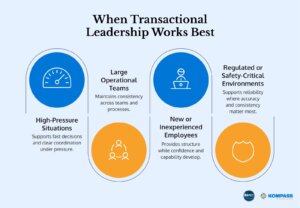
Transactional leadership is most effective in environments where coordination, reliability, and operational accountability directly influence performance and operational stability.
Leading During High-Pressure Situations
In high-pressure environments, speed and clarity often matter more than extended consultation. During operational disruptions, safety incidents, or deadline-critical projects, teams need clear priorities, defined responsibilities, and fast decision-making. It provides the structure that helps people respond quickly and work in alignment under pressure.
Supporting Consistency Across Large Teams
Maintaining standards across departments, locations, or rotating shifts requires more than leadership presence alone. It supports consistency through structured processes, clear expectations, and repeatable systems that help large teams operate cohesively across different environments.
Working With Inexperienced Teams or New Employees
New employees and developing professionals often benefit from guidance before autonomy. Clear expectations, structured feedback, and defined responsibilities help people build confidence and competence before taking on greater independence. Applied well, this leadership creates the stability that people often need before greater independence becomes possible.

Regulated or Safety-Critical Environments
In environments where safety, compliance, or operational accuracy are critical, clear processes and consistent oversight become essential. Healthcare, aviation, logistics, and financial operations often depend on structured systems that reduce ambiguity and support reliable decision-making under pressure.
The Advantages of Transactional Leadership
When applied in the right context, transactional leadership can create strong operational stability and coordination, particularly in environments where reliability and operational coordination are essential.
Some of the key advantages include:
- Clear expectations and defined responsibilities across teams
- Greater consistency in processes, communication, and performance standards
- Faster coordination during high-pressure or time-sensitive situations
- Stronger accountability within structured environments
- Improved reliability in regulated, operational, or safety-critical workplaces
- More predictable decision-making and workflow management
In many organisations, these are not minor advantages. They help teams operate more efficiently, reduce confusion, and maintain performance under pressure.
The Limitations of Transactional Leadership
Understanding where it works well also means recognising where it may begin to limit growth, initiative, and long-term development.
Over-Reliance on External Motivation
When recognition and accountability become the primary drivers of behaviour, intrinsic motivation can weaken over time. People may meet expectations consistently without developing the curiosity, initiative, or independent thinking that many organisations increasingly depend on.
Excessive Structure Can Reduce Ownership
Clear guidance can support performance, particularly in operational environments. However, when people rely too heavily on instruction and supervision, they may struggle to develop confidence and judgement independently. Over time, this can create dependency rather than capability within teams.
Not Every Situation Requires Directive Leadership
Some organisational challenges, including innovation, collaboration, and people development, require greater flexibility than this leadership typically provides. Leadership maturity depends partly on recognising when structure supports performance and when it begins to restrict growth and adaptability.

Common Misunderstandings About Transactional Leadership
Transactional leadership is often misunderstood as rigid, controlling, or outdated. In practice, its effectiveness depends less on the framework itself and more on how it is applied within a team or organisation.
Some of the most common misconceptions include:
- Assuming structure automatically limits trust or autonomy
- Confusing accountability with micromanagement
- Treating this leadership as inherently negative rather than context-dependent
- Believing rewards and consequences are the only drivers of performance
- Applying the model too rigidly in situations that require creativity or collaboration
Problems usually emerge when this leadership becomes the only approach a team experiences. Structure can support performance effectively, but excessive control can eventually limit ownership, confidence, and adaptability.
Transactional vs Transformational Leadership
These approaches are often treated as opposites, but effective leadership depends more on recognising what a situation requires. Transactional and transformational leadership each serve different purposes depending on the environment, the team, and the nature of the challenge.
| Transactional Leadership | Transformational Leadership | |
| Focus | Structure and consistency | Vision and innovation |
| Motivation | External accountability | Internal purpose |
| Timeframe | Short-term coordination | Long-term change |
| Approach | Clear processes and oversight | Shared purpose and inspiration |
| Best suited to | Operational stability | Strategic or cultural transformation |
Strong leaders rarely rely entirely on one leadership approach. Different situations require different forms of guidance, structure, and communication. Developing the judgement to move between these approaches often comes through experience, reflection, and coaching skills development.
The Role of Self-Awareness in Leadership Style
Leaders often default to familiar habits. Some rely too heavily on structure and oversight, even with capable teams, while others avoid accountability conversations in an effort to preserve harmony. Transactional leadership becomes more effective when applied intentionally rather than automatically. This requires self-awareness, recognising personal tendencies, understanding what the team actually needs, and adjusting leadership style accordingly.
Transactional Leadership in Hybrid and Multicultural Workplaces
Hybrid and internationally diverse workplaces add further complexity to how this leadership is applied. In remote or distributed teams, accountability structures often need to be more explicit, but excessive monitoring can quickly weaken trust, particularly in cultures where autonomy is closely connected to professional respect.
Across the UAE and wider MENA region, effective transactional leadership depends not only on clear expectations and communication, but also on cultural awareness and communication sensitivity. Different team members may respond to structure, authority, and feedback in very different ways. Leaders who apply the model well understand how to balance accountability with trust across diverse working environments.

Transactional Leadership and Coaching
Accountability, standards, and operational clarity still matter within a coaching-oriented environment. What changes is how accountability and guidance are communicated and supported. Rather than focusing only on compliance, a coaching-informed approach also helps people develop confidence, judgement, and ownership over time.
It becomes more effective when leaders recognise when structure is supporting performance and when it is beginning to restrict growth. Developing that awareness often comes through reflection, experience, and coaching supervision.