
Leadership rarely succeeds through one fixed approach. A leader who gives clear direction to a new team member may frustrate an experienced professional who simply needs space to work. Equally, delegating too quickly can leave someone navigating unfamiliar territory feeling unsupported.
This is the tension situational leadership theory was designed to address. Rather than prescribing one leadership style, it asks leaders to assess what the situation actually requires and adapt accordingly. In increasingly complex workplaces, that adaptability has become essential.
What Is Situational Leadership?
Situational leadership is a model developed by Paul Hersey and Ken Blanchard based on the idea that there is no single best way to guide people. The approach encourages leaders to adapt according to the individual, the situation, and the level of support required at a given moment.
Rather than relying on one fixed leadership style, the model focuses on flexibility, responsiveness, and the ability to adjust according to changing levels of competence, confidence, and readiness.
Why Situational Leadership Remains Relevant Today
The need for leadership adaptability has become more visible as workplaces grow more complex, fast-moving, and culturally diverse.

Modern Leadership Is Increasingly Complex
The environments leaders operate in today look very different from the ones this model was originally developed for. Hybrid working has changed how teams communicate and collaborate. Organisations are changing more quickly, and experience levels within the same team can range from new graduates to seasoned specialists. In many workplaces, uncertainty is no longer occasional. It has become a constant factor in unpredictable situations where leaders must expertly direct their teams through volatility.
In this context, relying on one leadership style can limit both performance and development. Situational leadership offers a more responsive approach, helping leaders adjust according to the needs of the individual, the task, and the wider environment.
Different People Require Different Forms of Leadership
No single leadership approach works equally well for every person or situation. Confidence, motivation, and capability shift over time. Someone who works independently in one area may need more guidance when stepping into unfamiliar responsibilities or periods of change.
Situational leadership is less about controlling people and more about recognising what supports growth, ownership, and effective decision-making in a given moment. For leaders invested in leadership development, that distinction matters.
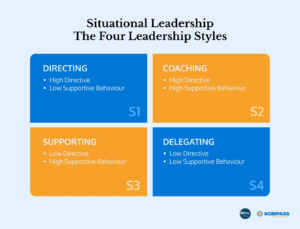
The Four Styles of Situational Leadership
Situational leadership theory is built on the principle that effective leadership should adapt alongside the development of the individual or team. The model outlines four leadership styles, each suited to a different balance of capability, confidence, and support needs.
A leader may move between these approaches depending on the situation, the individual, and the level of guidance required at that stage.
Directing (High Direction, Low Support)
This approach involves clear instruction, close supervision, and structured guidance. The leader defines responsibilities, sets expectations, and monitors progress carefully. It is most useful during onboarding, unfamiliar tasks, or situations where clarity and speed are essential.
Someone entering a new role often needs structure before they can confidently exercise judgement. At this stage, direction provides stability rather than control.
Coaching (High Direction, High Support)
The coaching style combines guidance with encouragement. The leader continues to provide direction while also inviting discussion, explaining decisions, and supporting the individual’s development. This approach is particularly useful when capability is growing but confidence is still developing.
A high-potential employee stepping into leadership responsibilities may need both challenge and reassurance. Effective coaching helps create the confidence to apply developing skills in practice.

Supporting (Low Direction, High Support)
As capability strengthens, leadership becomes less directive and more collaborative. The focus shifts towards listening, shared problem-solving, and creating space for independent thinking. This style works well for individuals who are capable but navigating uncertainty, pressure, or change.
An experienced team member during organisational restructuring may not need instruction. They may need support, perspective, and the confidence to work through complexity.
Delegating (Low Direction, Low Support)
With experienced and self-directed individuals, leadership often becomes lighter in touch. The leader clarifies outcomes, aligns expectations, and trusts the individual to manage the work independently. Excessive involvement at this stage can reduce ownership and slow decision-making.
Delegation in this leadership is not withdrawal. It reflects confidence in the individual’s capability and judgement.
Understanding Readiness in Situational Leadership
One of the most important aspects of the model is recognising that readiness is not fixed. A highly capable individual may still need support when stepping into unfamiliar responsibilities, navigating uncertainty, or leading for the first time.
This is what makes situational leadership more nuanced in practice. The same person may require different forms of guidance across different situations depending on their confidence, motivation, and context.
Real-World Examples of Situational Leadership
Situational leadership becomes most visible in moments where people, pressure, and context are constantly shifting.
Leading Through Organisational Change
When priorities shift, structures change, or uncertainty increases, even experienced professionals can lose confidence in familiar ways of working. During these periods, leaders often need to provide more clarity, communication, and reassurance than they would under stable conditions. The challenge is rarely capability alone. More often, the challenge lies in helping people navigate uncertainty while maintaining trust and direction.
Supporting First-Time Managers
Professionals stepping into their first leadership role often bring technical expertise but limited experience managing people. Early on, clearer guidance and regular support help them build confidence and judgement. As experience develops, leadership can gradually shift towards greater autonomy and shared decision-making.
Leading High-Performing Teams
One of the most common leadership mistakes with strong teams is unnecessary involvement. When individuals are capable, motivated, and trusted, excessive oversight can slow decision-making and reduce ownership. In these situations, effective leadership often means creating clarity around outcomes while giving people the space to lead their work independently.
Leading Across Multicultural Teams
In multicultural workplaces, leadership flexibility becomes especially important. Communication styles, attitudes towards hierarchy, and expectations around feedback can vary significantly across cultures. An approach that feels supportive in one context may feel unclear or overly direct in another. This helps leaders respond more thoughtfully across diverse teams and working environments.

The Benefits of Situational Leadership
One of the strengths of situational leadership is its flexibility. Rather than relying on a single leadership style, leaders adapt their approach according to the needs of the individual, the situation, and the wider working environment.
- Encourages more responsive and adaptable leadership
- Strengthens communication and trust within teams
- Supports the development of confidence, ownership, and autonomy
- Helps leaders navigate change and uncertainty more effectively
- Improves leadership effectiveness across multicultural teams and workplaces
Common Misunderstandings About Situational Leadership
Adapting leadership approaches based on the situation is often misunderstood as simply switching styles depending on the circumstance. In practice, the model requires far more judgement and self-awareness than that. Adapting your approach does not mean abandoning consistency, lowering standards, or trying to please everyone.
Some of the most common misunderstandings include:
- Assuming flexibility means changing values or expectations
- Confusing responsiveness with accommodation
- Applying the model too mechanically without considering individual nuance
- Treating people as fixed categories rather than recognising that readiness can shift over time
- Focusing only on behaviour while overlooking the importance of judgement and self-awareness
Situational leadership theory provides a useful framework, but people and workplaces are often more complex than any model can fully capture. Effective leadership still depends on the ability to interpret situations thoughtfully rather than apply techniques rigidly.

The Role of Self-Awareness in Situational Leadership
Many leaders default to familiar leadership habits, especially under pressure. Self-awareness is among the essential characteristics of a good leader, creating the ability to recognise when a different approach may be needed rather than leading from habit alone.
Over-directing can limit ownership in capable teams, while delegating too early can leave people unsupported. Situational leadership becomes more effective when leaders develop the awareness to adjust intentionally according to the individual, the situation, and the level of support required. Coaching skills can also play an important role in strengthening that awareness.
How to Apply Situational Leadership More Effectively
Applying this leadership well requires more than moving mechanically between leadership styles. It depends on observation, judgement, and the ability to respond appropriately to what people need in a given moment.
- Observe before responding: Effective leaders assess not only capability, but also confidence, motivation, and context before deciding how to lead.
- Balance support with accountability: Flexibility should not come at the expense of clarity. Support works best when combined with clear expectations and responsibility.
- Adapt intentionally: Sudden shifts in leadership style can create confusion. Strong leaders adjust gradually, allowing trust and confidence to develop over time.
Situational Leadership and Coaching
Situational leadership and a coaching approach share an important principle: effective leadership begins with understanding what the individual needs before deciding how to respond. Both approaches encourage leaders to listen carefully, develop autonomy, and resist solving problems too quickly on behalf of others.
Leaders who develop coaching skills often become more adaptable in practice. They become better at recognising when to guide, when to support, and when to step back while still maintaining accountability. Coaching supervision can further strengthen this awareness over time.
Key Takeaways
Situational leadership is less about mastering a fixed leadership style and more about developing the ability to respond thoughtfully to different people, situations, and levels of readiness.
- Effective leadership adapts according to the individual, the context, and the level of support required at a given moment.
- Readiness is not fixed. Confidence, capability, and motivation can shift across different situations and stages of development.
- Situational leadership becomes more effective when combined with self-awareness, judgement, and a coaching mindset that supports autonomy without losing accountability.