

Most people associate negotiation with formal business deals, salary conversations, or commercial agreements with a clear winner and loser. In reality, these conversations happen throughout professional life, from managing expectations and influencing decisions to balancing competing priorities within a team.
The challenge is that most people have never been taught how to approach them well.
In multicultural, hybrid, and high-pressure workplaces, strong negotiation skills are no longer optional. They shape how professionals communicate, build trust, navigate tension, and work through complex conversations productively.
What Are Negotiation Skills?
Negotiation skills are the communication, listening, and decision-making abilities that help people manage expectations, navigate tension, and reach workable outcomes with others. These include active listening, emotional regulation, preparation, adaptability, and clear communication.
In professional environments, these skills are rarely limited to formal deals or high-stakes discussions. Many everyday workplace interactions involve balancing priorities, aligning responsibilities, addressing conflict, or managing professional boundaries. Strong communication and negotiation skills help these conversations remain constructive rather than becoming unnecessarily difficult or adversarial.

Why Negotiation Skills Matter in Professional Life
Negotiation shapes how people build alignment, manage expectations, handle disagreement, and maintain working relationships. Yet it is often treated as a specialist skill rather than a core part of professional communication.
In practice, many workplace tensions are negotiation challenges at their core. Differences in priorities, assumptions, or communication styles rarely require dramatic intervention. More often, they require people who can listen carefully, communicate clearly, and work towards shared understanding.
Strong negotiation skills help professionals:
- Prevent misunderstandings from escalating unnecessarily
- Navigate disagreement more constructively
- Build trust across teams and stakeholder relationships
- Communicate expectations more clearly
- Maintain productive working relationships under pressure
This is as relevant to leadership development as it is to everyday workplace communication.
What Makes a Strong Negotiator?
The popular image of a strong negotiator as confident, persuasive, and quick-thinking is only partially accurate. The people who consistently handle difficult conversations well often rely more on emotional regulation, preparation, curiosity, and the self-awareness to adapt their approach when needed.
Strong negotiators are rarely the loudest people in the room. More often, they are the ones who listen carefully, remain composed under pressure, and recognise the difference between what someone says they want and what they actually need.
This is where negotiation becomes less about tactics and more about communication, trust, and shared understanding.
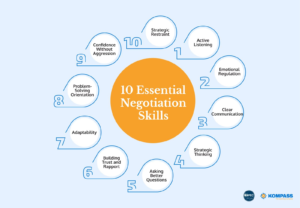
10 Negotiation Skills Every Professional Should Master
Effective negotiation depends less on persuasive tactics and more on how people communicate, listen, and respond under pressure.
1. Active Listening
Active listening is one of the most underestimated negotiation skills. It involves more than hearing words. It requires noticing hesitation, recognising emotional cues, and understanding what matters beneath the surface of what someone is saying.
In workplace discussions, people respond differently when they feel genuinely heard. Active listening reduces misunderstanding, builds trust, and creates the conditions for more honest and productive dialogue.
2. Emotional Regulation
Your ability to remain composed during pressure or disagreement shapes outcomes more than most people realise. Defensive or emotionally reactive responses often narrow conversations rather than move them forward.
Emotional regulation is not about suppressing emotion. It is about recognising your triggers, creating space before reacting, and choosing how to respond intentionally. Over time, this becomes one of the clearest differences between professionals who handle difficult conversations well and those who consistently find them draining.

3. Clear and Respectful Communication
Ambiguity is one of the most common sources of workplace friction. When expectations are unclear, commitments remain vague, or difficult issues are avoided, misunderstandings build quickly. Effective negotiation requires people to communicate clearly, set expectations directly, and do so in a way that still respects the other person.
This matters even more in multicultural and hybrid workplaces, where assumptions about tone, directness, and professional norms can differ significantly. Strong communicators know how to balance clarity with respect, whether discussing deadlines, aligning priorities, or addressing tension before frustration escalates.
4. Preparation and Strategic Thinking
Entering a negotiation unprepared is one of the most avoidable professional mistakes. Preparation involves more than knowing what you want. It requires understanding what the other person is likely to prioritise, recognising where common ground exists, and knowing your own boundaries before the conversation begins.
Concepts such as BATNA, your best alternative to a negotiated agreement, are useful not as academic theory but as practical preparation tools. When you understand your alternatives clearly, conversations become more grounded, confident, and less reactive.
5. Asking Better Questions
The quality of a negotiation is often shaped by the quality of the questions asked within it. Open-ended questions help uncover assumptions, move conversations away from fixed positions, and encourage people to express what genuinely matters to them.
This is where negotiation and coaching skills overlap closely. Rather than pushing towards an answer immediately, skilled professionals ask questions that open up thinking and create space for better dialogue. “What would a good outcome look like for you?” is often more productive than a persuasive argument.

6. Building Trust and Rapport
People collaborate more openly when they feel respected and understood. Trust develops through consistency, credibility, and honest communication over time, and it shapes how openly people engage during difficult discussions.
Professionals who build genuine rapport rely less on persuasion tactics because conversations begin from a stronger foundation. People become more willing to share concerns, acknowledge limitations, and work towards outcomes that feel workable for everyone involved.
7. Adaptability
No two negotiations are the same, and no single communication style works in every context. Effective negotiators adapt their approach by reading the situation, responding to changing dynamics, and navigating cultural differences with awareness and sensitivity.
In UAE and MENA workplaces, where teams are often internationally diverse, adaptability is especially important. Some people value directness, while others may experience it as confrontational. Some discussions require explicit agreement, while others depend more heavily on trust and relationship-building over time. Recognising these differences and adjusting accordingly is a professional skill in itself.
8. Problem-Solving Orientation
The most effective negotiations focus on solving a shared problem rather than winning an argument. When people approach disagreement with curiosity and a willingness to understand different priorities, conversations become more constructive and workable solutions begin to emerge.
This does not mean compromising on everything that matters to you. It means being clear about priorities, open about constraints, and willing to explore options that may not have been obvious at the beginning. At its best, negotiation is collaborative thinking under pressure.
9. Confidence Without Aggression
There is an important difference between assertiveness and aggression. Communicating boundaries clearly, holding a position under pressure, and declining what does not work for you are all expressions of confidence. None of them require dominance or confrontation.
Confidence becomes more credible when paired with composure and restraint. People are often more persuaded by someone who remains calm, listens carefully, and communicates clearly than by someone who argues forcefully. The goal is not to overpower the other person, but to be taken seriously.
10. Knowing When to Pause or Walk Away
Sometimes the most effective negotiation skill is restraint. Recognising when a discussion has become unproductive, when emotions are too heightened for clarity, or when the terms are simply not workable requires professional judgement and self-control.
Not every agreement is worth reaching, and not every conversation needs to continue immediately. Knowing when to pause, step back, or walk away is often a sign of maturity rather than avoidance.
Common Negotiation Mistakes Professionals Make
Many negotiation problems begin before the conversation itself. Poor preparation, assumptions about the other person’s priorities, or entering a discussion while emotionally reactive can shape outcomes negatively from the outset.
Some of the most common mistakes include:
- Talking more than listening
- Focusing only on winning rather than shared outcomes
- Reacting defensively to challenge or disagreement
- Confusing assertiveness with aggression
- Entering conversations without clear preparation or boundaries
- Overlooking cultural differences in communication styles and expectations
Improvement begins with the willingness to reflect honestly on your own communication habits and negotiation approach.

Common Misunderstandings About Negotiation
Negotiation is often misunderstood as persuasion, dominance, or the ability to “win” conversations. In reality, the people who handle negotiation most effectively are rarely the most forceful voices in the room.
Some of the most common misconceptions include:
- Assuming negotiation only matters during formal business discussions
- Confusing assertiveness with aggression
- Believing compromise always means losing something important
- Prioritising persuasion over understanding
- Treating negotiation as competition rather than collaborative problem-solving
Effective negotiation depends less on controlling people and more on communicating clearly, understanding priorities, and working towards outcomes that remain constructive over time.
Negotiation Skills in Multicultural Workplaces
Professional communication differs across cultures. Attitudes towards directness, hierarchy, disagreement, and silence vary considerably, and what feels confident in one context may be perceived very differently in another.
In the UAE and across MENA’s internationally diverse workplaces, effective negotiation requires cultural awareness alongside communication skill. Professionals need to recognise different expectations around trust, agreement, and feedback, particularly in hybrid and remote environments where relational cues are more limited and clarity matters even more.

Can Negotiation Skills Be Developed?
They can, and often more easily than people assume. Strong negotiators are rarely born naturally confident. Most develop the skill gradually through experience, reflection, feedback, and a willingness to examine what is and is not working in their communication.
Working with a coach or engaging in coaching supervision can also help people recognise unhelpful habits and improve how they approach difficult conversations. Negotiation skills are not fixed personality traits. They are professional capabilities that strengthen over time through practice and self-awareness.
The Role of Self-Awareness in Negotiation
Many negotiation difficulties stem less from strategy and more from unexamined communication habits or emotional reactions. Defensiveness, avoidance, over-explaining, or assuming your communication style is the only reasonable one can quietly shape how conversations unfold.
Self-awareness helps people recognise these patterns and respond more intentionally. When professionals understand their own triggers, assumptions, and default behaviours, negotiation becomes less about controlling the other person and more about communicating with clarity, composure, and care.
Key Takeaways
Strong negotiation skills are built through self-awareness, communication, and the ability to navigate difficult conversations constructively in different professional contexts.
- Effective negotiation depends as much on listening, emotional regulation, and adaptability as it does on confidence or persuasion.
- Many workplace tensions can be resolved more productively when people focus on shared understanding rather than simply trying to win an argument.
- In multicultural and high-pressure environments, strong negotiators combine clear communication with cultural awareness, composure, and professional judgement.