
You have built a career that looks right on paper. But something feels misaligned, and you are not sure whether to push forward or pivot entirely. In our experience, this is one of the most common reasons professionals first seek career guidance.
Career paths today are rarely straight lines, and the pressure to make the right professional decisions keeps growing. Career guidance brings clarity to that confusion and turns uncertainty into a deliberate plan.
Whether you are just starting out or reconsidering everything you have built, this is where that process begins.
What Is Career Guidance?
At its simplest, it is a structured, ongoing process that helps you understand who you are professionally, explore your options honestly, and make informed decisions about your career. It is not a one-off session or a personality test. It is a continuous process that evolves as you do.
At its core, it brings together three essential elements: self-understanding, market awareness, and strategic decision-making. When these work together, you stop drifting and start directing your own path.
Key Components to Look For
This process is both reflective and practical, looking inward and forward at the same time. It typically involves:
- Assessing your skills, strengths, and interests with genuine depth
- Aligning your choices with your personal values and personality
- Exploring roles and industries that hold real potential for you
- Building a structured plan to move forward with confidence
Why Career Guidance Matters in Professional Landscape
The professional world is changing faster than most people can keep up with. Roles that existed a decade ago are disappearing. New industries are creating entirely new demands. And nowhere is this felt more acutely than in a market, where ambition runs high, competition is global, and career decisions carry significant weight.
Research from the OECD’s Career Guidance Policy Review consistently highlights that without structured career support, individuals are significantly more likely to make uninformed choices, experience lower job satisfaction, and struggle to navigate transitions effectively.
Poor career decisions carry a real cost, not just financially, but in lost time, direction, and potential. It reduces that cost by helping you ask better questions, make clearer choices, and stay adaptable as your circumstances evolve.
Key Benefits of Career Guidance
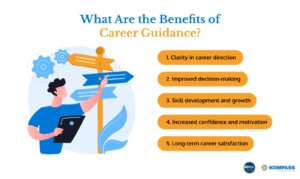
The impact of good guidance extends well beyond finding the right job. When the process is done well, it changes how you see yourself, how you make decisions, and how you move through your professional life.
Clarity and Better Decision-Making
Many people feel stuck not because they lack ability, but because they lack direction. When you understand your values and the landscape of opportunities available to you, decisions become grounded rather than reactive, and you begin choosing based on genuine alignment rather than fear or convenience.
Skill Development and Growth
It helps you identify where your strengths are and where the gaps lie. Rather than waiting for an annual review to tell you what is missing, you take an active role in building the capabilities your goals actually require.
Confidence, Motivation, and Long-Term Satisfaction
A study published in the Journal of Vocational Behavior found that individuals who received structured career support reported higher levels of professional confidence and stronger long-term resilience. There is a meaningful difference between tolerating a career and finding genuine purpose in one, and guidance supports paths that are not only successful by conventional measures but fulfilling and sustainable over time.

How It Works in Real Life
Career guidance is not abstract. It shows up in practical, tangible ways across every stage of a professional journey.
Working with a qualified career professional can support you with:
- Redesigning your CV so it reflects your direction, not just your history
- Preparing for interviews in a way that challenges how you think, not just what you say
- Planning a structured job search with clear focus and strategy
- Navigating a move between industries or career transitions with confidence
- Preparing for leadership roles that require a different version of yourself
- Re-entering the workforce after a career break or a period of personal change
In Dubai and Abu Dhabi, where we work with professionals from over 50 nationalities, our work often involves an added layer: helping people understand how their international experience, cultural background, and transferable skills position them powerfully in one of the world’s most competitive talent markets. That context matters, and good guidance accounts for it.
Who Truly Needs Career Guidance?
Not everyone who seeks guidance is lost. In fact, the most intentional professionals are often the ones who seek support earliest, because they understand that moving forward with clarity is always better than moving forward alone.
Students and Early-Career Professionals are navigating some of the most consequential decisions of their working lives, often without a clear sense of where they fit or what they truly want. The habits and reputations built in these early years have a compounding effect that most people only recognise in hindsight.
Mid-Career Professionals often reach a point where external success no longer feels internally satisfying. This is one of the most important crossroads you can face, and it deserves more than guesswork.
Career Switchers face the added complexity of moving into unfamiliar territory, where enthusiasm alone is rarely enough. A structured process makes the difference between a confident transition and a costly one.
Organisations and HR Teams use it to support talent development, improve retention, and align people with roles where they are most likely to contribute and grow. For us, this is a core part of how we approach human capital development at an organisational level.
Beyond these broader profiles, there are specific moments in a professional life when guidance moves from helpful to necessary: feeling stuck or chronically unmotivated, facing redundancy or unexpected job loss, preparing for a significant career change, considering a return to work after time away, or experiencing a persistent lack of direction that reflection alone cannot resolve.
These are the moments that define what comes next, and having structured support during them is one of the clearest signs of professional self-awareness.

Where Can You Get Career Guidance?
Support is more accessible today than it has ever been. Depending on where you are in your journey, there are several settings where you can find meaningful support, each offering something different.
Educational Institutions and Community Programmes
Schools, universities, and career centres provide foundational support, particularly for students navigating early decisions about their professional direction. Public and non-profit services extend that access further, ensuring that meaningful career support is not reserved for those who can afford private coaching.
Professional Career Coaching Services
Working one-to-one with a qualified career coach offers the most personalised and structured experience available. This is particularly valuable during pivotal transitions or when the stakes of your next decision feel especially high. When evaluating options, look for accredited career coaching programmes that offer both structure and genuine personalisation.
Workplace and Organisational Programmes
Many forward-thinking organisations invest in internal career development support as part of their broader human capital strategy. When done well, it helps employees grow within the organisation rather than away from it, which benefits everyone.

Accessible Options Worth Exploring
Support does not have to be expensive or exclusive to be effective. Digital assessments, self-guided courses, and online career planning tools offer a flexible and accessible starting point, particularly for those in the early stages of figuring out what they want. Free resources through public libraries, government employment services, and community organisations extend that access further. For those ready to invest more time and structure into the process, working with a professional career coach offers a more personalised and in-depth experience.
The right option depends entirely on where you are in your journey and what level of support your situation genuinely calls for.
Common Misconceptions Worth Addressing
A few persistent myths are worth addressing directly.
“This is only for students.” Professionals at every stage benefit from structured reflection and external perspective, including senior leaders and experienced executives who have spent decades building their careers.
“It is a one-time solution.” A single session can be a useful starting point, but lasting change comes from an ongoing process that adapts as your career and circumstances evolve.
“It guarantees a perfect career.” It does not. What it does is give you a significantly better chance of building one that is genuinely right for you.
“You only need it during a crisis.” Some of the most valuable guidance happens during periods of relative stability, when you have the clarity and headspace to think deliberately about what comes next.
Key Elements of an Effective Career Guidance Process
What makes the difference between guidance that transforms and guidance that merely informs comes down to a few consistent foundations.
Effective guidance always begins with honest self-assessment, understanding your strengths, interests, and values before anything else is decided. From that foundation, career exploration becomes genuinely useful, broadening your perspective and regularly surfacing options you would never have identified on your own.
Goal setting then gives that clarity direction, turning intention into a structured plan you can actually move towards. Equally important is the environment in which that process happens, one built on genuine trust and confidentiality where you can think out loud and sit with uncertainty without feeling judged.
A qualified career professional is what ties all of this together, bringing both structure and perspective, asking the questions you have not thought to ask yourself and helping you see patterns in your own story that are easy to miss from the inside. Insight without action changes nothing, which is why the most effective guidance processes move deliberately from clarity to momentum through concrete planning, accountability, and continuous adaptation.

How It Supports Personal and Professional Transformation
At its deepest, this process is about more than finding a better job or reaching the next level. It is about aligning what you do with who you are.
When your career reflects your values and connects to a genuine sense of purpose, the impact extends well beyond any single role. You become more engaged, more resilient, and more capable of sustained, meaningful growth.
This is the transformation a personalised coaching approach makes possible. Not overnight, but consistently, deliberately, and with the right guide alongside you. It is a transformation we have been committed to making possible since 2010, and it remains the reason we do what we do.
When Should You Seek Career Guidance
Most people wait too long. The right moment to seek guidance is before a decision becomes urgent, not after it already feels overwhelming.
If you are entering the workforce, considering a change of industry, experiencing stagnation, or preparing for a role that requires a different version of yourself, structured support will shorten the distance between where you are now and where you genuinely want to be.
Your Next Step in Career Guidance
The professionals who grow the furthest are rarely the ones who leave their careers entirely to chance. They are the ones who approach their own path with honest reflection, informed support, and the courage to make deliberate choices at the moments that matter most.
The careers that mean the most are rarely shaped by circumstance alone. They are built gradually, through self-awareness, purposeful planning, and a willingness to seek the right support at the right time.